
introduction
For the complete testing sequence, see the pregnancy test guide before choosing another test.
For more timing, result, and retesting guidance, browse the Pregnancy Tests hub.
Expiration dates on pregnancy tests matter more than most people expect. A pregnancy test is a chemical device: the antibodies printed onto the strip are what detect hCG, and they degrade with time, heat and humidity. Once they have degraded, the test can still look perfectly normal while quietly failing to detect a pregnancy that is definitely there.
This guide is the practical one: exactly where the date is printed on each part of the packaging, how to decode EXP and LOT codes, how long tests last from manufacture, what expiry does to accuracy in each direction, and what to do if the only test in the cupboard turns out to be out of date. If you want the wider picture on shelf life and false results, our companion guide answers can pregnancy tests expire in more depth.
Where to Find the Expiration Date on a Pregnancy Test
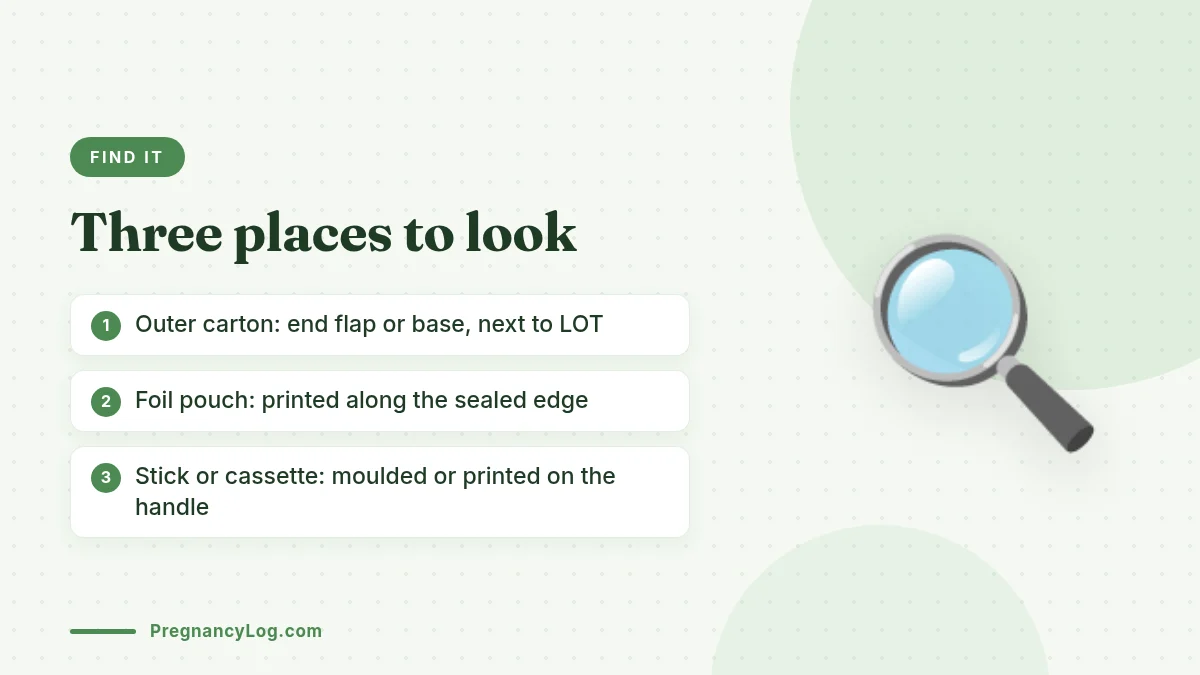
Manufacturers print the date in up to three places, and you only need to find one of them:
- The outer carton. Look at the end flaps or the base panel. The date usually sits beside a LOT or batch number and is labelled EXP, Exp. Date, Use by, or marked with the hourglass symbol used on medical devices.
- The individual foil pouch. This is the one that matters if you have loose tests with no box. The date is printed in small type along one of the sealed edges, often beside the lot code.
- The test stick or cassette itself. Many digital tests and some strips have the date printed or moulded onto the plastic handle.
If the pouch is unmarked and the box is long gone, treat the test as unreliable. There is no way to tell a two-month-old strip from a three-year-old one by looking at it, and guessing is how people end up trusting a false negative. Cheap strip tests bought in bulk are the most common culprits here.
Two symbols worth recognising on the packaging: the hourglass means “use by”, and the factory icon beside a date means date of manufacture, not expiry. If you only have a manufacture date, add the shelf life from the leaflet usually two to three years.
How to Read Pregnancy Test Expiry Date Codes
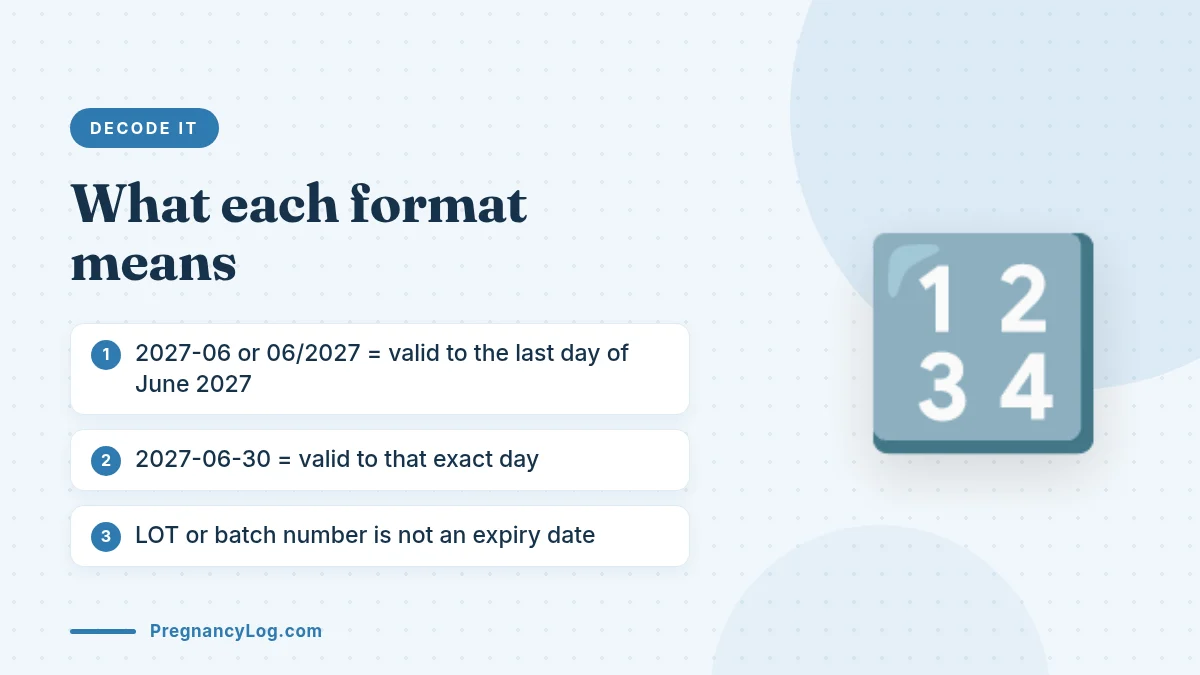
Year-month only (2027-06, 06/2027, JUN 2027):
the test is good until the last day of that month. A test marked 06/2027 is fine on 30 June 2027 and expired on 1 July 2027.
Full date (2027-06-30, 30/06/2027, 06/30/2027):
valid through that specific day. Watch the order — European packaging uses day/month/year while US packaging uses month/day/year, so 06/03/2027 is either 6 March or 3 June depending on origin. If the first number is above 12 it must be the day.
LOT / batch numbers
(often long alphanumeric strings) identify the production run for recalls. They are not dates, and any date embedded in them is a manufacturing code you cannot reliably decode at home.
Typical shelf life
is two to three years from manufacture for midstream and cassette tests, and often shorter sometimes 12 to 24 months for cheap strip tests. Digital tests have batteries and electronics, so they are no more durable than the chemistry; treat their dates just as strictly.
A note on retail stock:
a test bought today may already be well into its shelf life. Check the date at the shop or on delivery, especially with bulk multi-packs and marketplace sellers, and pick the longest-dated box on the shelf if you are stocking up.
What Actually Happens When a Pregnancy Test Expires
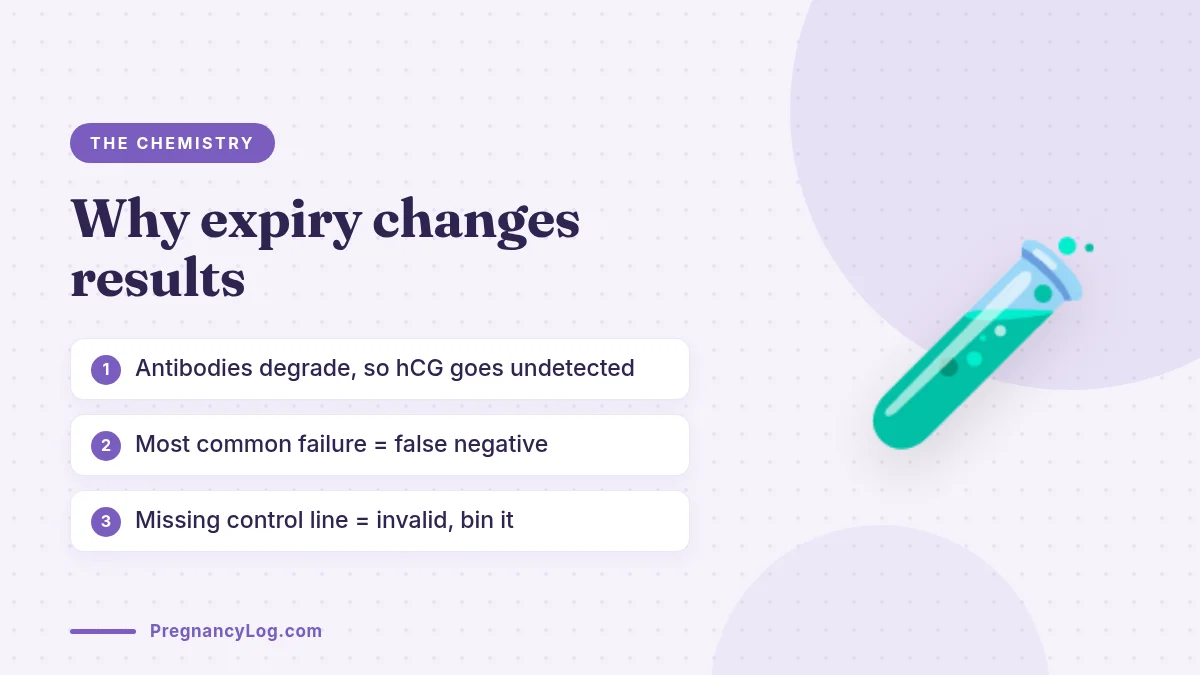
- False negatives are the main risk. The test simply fails to bind enough hCG to make a visible line, so a real pregnancy reads as negative. This is why an expired negative should never be trusted.
- Invalid results become common. If the control line does not appear, the test has failed outright. Bin it and use a fresh one — a missing control line makes the whole result meaningless, expired or not.
- Faint and ghost lines get harder to interpret. Degraded strips can produce shadowy marks, uneven dye migration or greyish lines that are neither positive nor negative. Our guide to faint lines explains what a real faint positive looks like.
What about false positives?
They are much less likely from expiry alone, because a positive line requires the antibody-dye reaction to work. A genuine second line on an expired test is more likely to be real than not — but it still needs confirming with an in-date test or a blood hCG before you rely on it.
Home tests are regulated medical devices and their stated accuracy — commonly quoted as over 99% from the day a period is due — applies only within the expiry date and storage conditions. Outside those, the manufacturer makes no claim at all. Both the NHS and MedlinePlus stress following the leaflet exactly, including the date.
Can You Use an Expired Pregnancy Test?
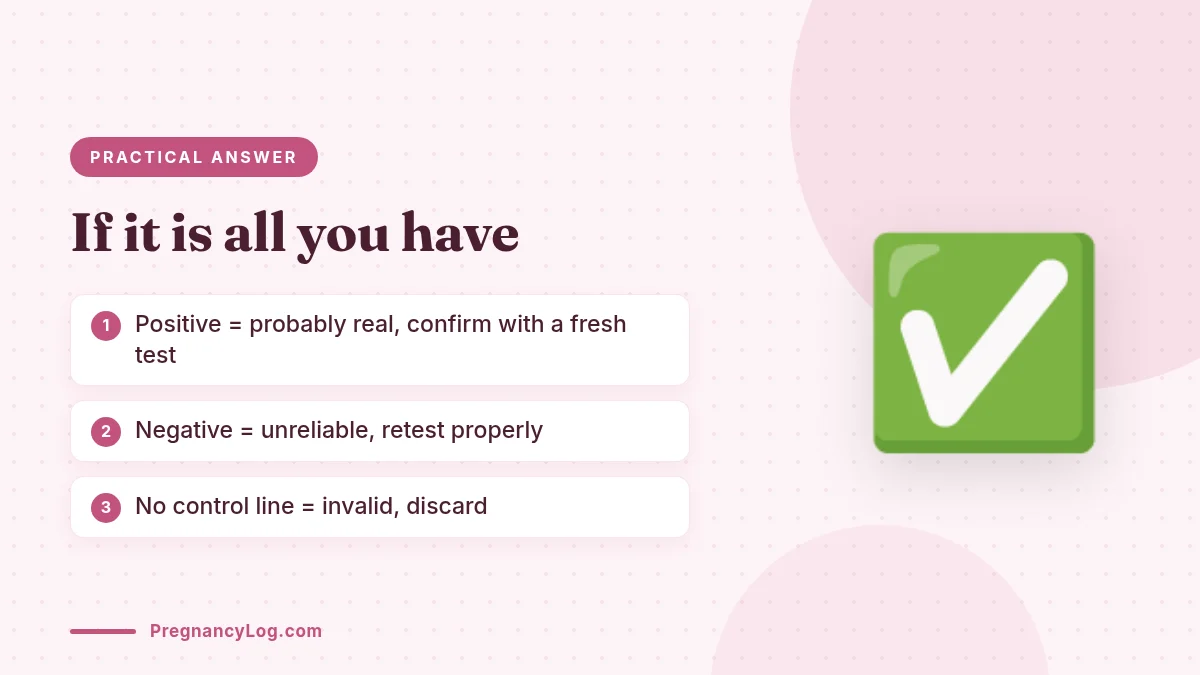
The honest answer: it is not recommended, but if it is 11pm and the only test in the house expired last month, the result still carries some information — as long as you read it correctly.
- Just past the date (days to a few weeks) and stored cool, dry and sealed: the test will often still work. Treat a positive as probably real and confirm within 24–48 hours; treat a negative as inconclusive.
- Months past the date, or stored in a bathroom cabinet, handbag or car: assume nothing. Heat and humidity destroy test chemistry faster than time alone.
- Any result with no control line: invalid. The test tells you nothing.
The safe protocol if you have used an expired test:
- Buy a fresh, in-date test — a single test costs less than the cost of being wrong.
- Retest with first-morning urine, when hCG is most concentrated.
- If results conflict, or you are already several days late, ask for a quantitative blood hCG. It detects from about 1–2 mIU/mL and gives an exact number.
- Keep taking folic acid and avoiding alcohol until you know.
Timing matters as much as expiry. A fresh test taken too early is just as capable of a false negative — see our guides to a negative test at 4 days late and negative tests after implantation bleeding. And if the test turns positive, the due date calculator will tell you how far along you are.
How to Store Tests So They Last to Their Expiry Date
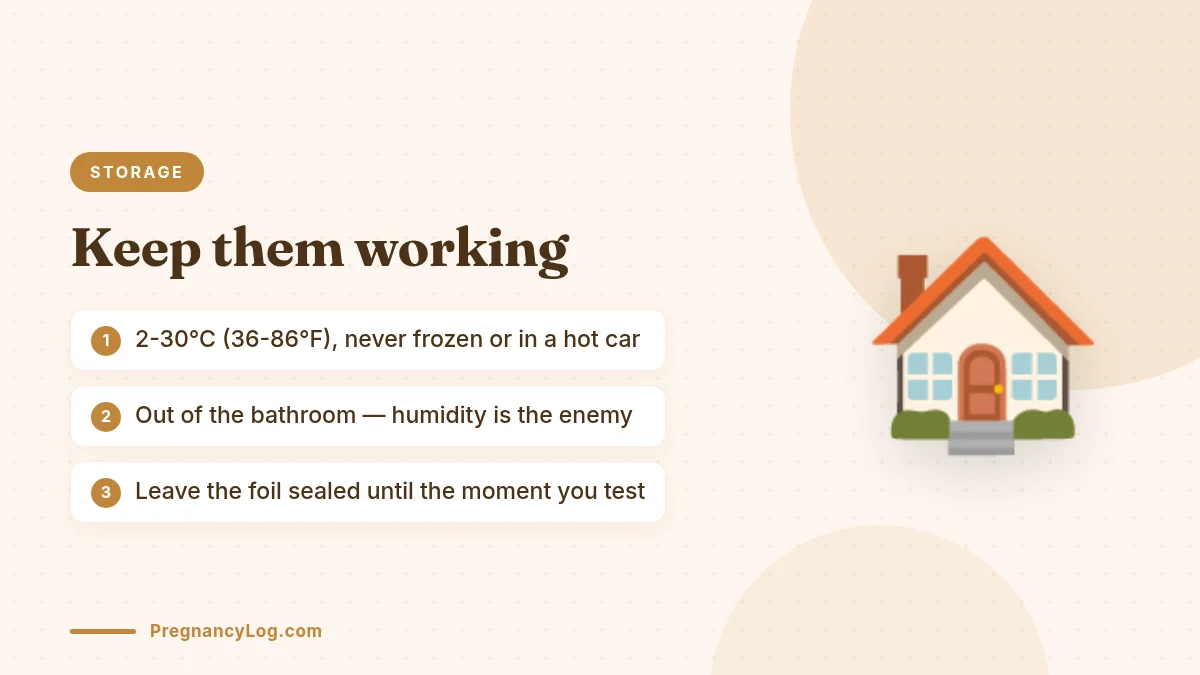
Most leaflets specify storage between roughly 2°C and 30°C (36–86°F), away from direct sunlight and moisture. In practice:
- Do not keep tests in the bathroom. It is the most common storage spot and the worst one: shower steam pushes humidity far above what the packaging is designed for.
- Do not leave them in a car, a windowsill or a bag in summer. A parked car easily exceeds 50°C.
- Do not refrigerate or freeze unless the leaflet says so, and if a test has been cold, let it reach room temperature before opening — condensation inside the pouch ruins the strip.
- Keep the foil pouch sealed until the moment you test. Once opened, the absorbent strip starts taking up ambient moisture and should be used within about an hour.
- Store in a bedroom drawer or a kitchen cupboard away from the kettle — dry, dark, stable temperature.
- Rotate stock. If you keep several tests, use the shortest-dated first and check dates every few months.
Bin any test whose pouch is torn, swollen or damp, and any test that has been through a hot wash or a suitcase in a hot country. A wasted test costs a couple of pounds; a false negative costs weeks.
Frequently Asked Questions
How long do pregnancy tests last before they expire?
Most midstream and cassette tests carry a shelf life of two to three years from manufacture, while inexpensive strip tests are often 12 to 24 months. The printed EXP date is what counts, not the purchase date — a test bought today may already be halfway through its life, so check the carton before you buy.
Can an expired pregnancy test give a false positive?
It is far less likely than a false negative, because a visible line requires the antibody and dye reaction to still work. Degraded tests can, however, produce faint grey shadows, evaporation lines or uneven marks that are easy to misread as positive. Any positive from an expired test should be confirmed with an in-date test or a blood hCG.
Can an expired pregnancy test give a false negative?
Yes, and this is the main risk. The antibodies that detect hCG degrade over time and in heat, so the test can fail to register a pregnancy that is genuinely there. Never rely on a negative result from an out-of-date test — retest with a fresh one using first-morning urine.
What if there is no expiry date on the pouch or box?
Do not use it for anything you need to trust. There is no way to judge age from appearance, and bulk strip tests are the most likely to be old. If the packaging only shows a manufacture date, add the shelf life stated in the leaflet usually two to three years and if that leaves any doubt, buy a fresh test.
Does the expiry date apply once the foil is opened?
No. Once the pouch is opened the strip begins absorbing moisture from the air, so the test should be used within about an hour regardless of the printed date. Open the foil only when you are ready to test.
Are digital pregnancy tests more affected by expiry?
They are affected the same way chemically, with the added issue of a battery and electronics that can fail. A digital test past its date may show an error symbol, a blank screen or an incorrect result. Because you cannot inspect a line yourself, an out-of-date digital test is the least informative option of all.
The Bottom Line
Expiration dates on pregnancy tests are printed in three places the carton, the foil pouch and often the stick and a year-month code means the end of that month. Most tests last two to three years from manufacture, and the antibodies that make them work degrade with time, heat and humidity.
The practical rule is simple: never trust a negative from an expired test, treat a positive as probably real but confirm it, and bin anything with no control line or no printed date. Store tests in a dry bedroom drawer rather than the bathroom, keep the foil sealed until you use it, and check the date at the shop rather than at 6am on the morning you need an answer.
Watch: Truth About False Positive & False Negative Pregnancy Tests – Dr L
Watch this helpful video to learn more about expiration dates on pregnancy tests.