
introduction
For the complete testing sequence, see the pregnancy test guide before choosing another test.
For more timing, result, and retesting guidance, browse the Pregnancy Tests hub.
A 4 days late negative pregnancy test sits in the most frustrating gap in the whole cycle: late enough to feel significant, early enough that you cannot quite trust the result. The short answer is that a test taken four days after your period was due is roughly 99% accurate if you ovulated when you thought you did — and that last clause is where almost all the exceptions live.
Below you will find how the accuracy actually works at this point, the nine reasons a period runs late when you are not pregnant, exactly how and when to retest for a definitive answer, and the point at which a late period stops being a waiting game and becomes something to get checked.
How Accurate Is a Negative Test 4 Days After a Missed Period?
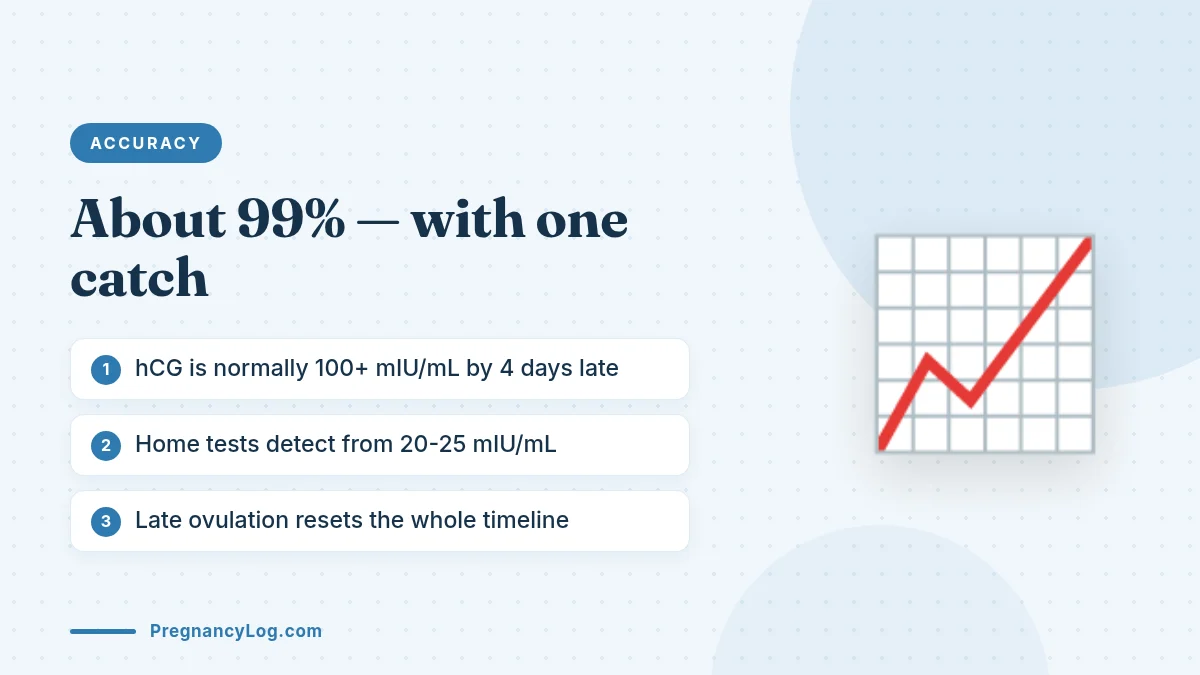
Pregnancy tests measure hCG. In a textbook 28-day cycle with ovulation on day 14, implantation happens around days 20–24, hCG becomes detectable in urine a few days later, and by four days past your expected period (roughly 18 DPO) levels are usually well into the hundreds of mIU/mL. Home tests trigger at 20–25 mIU/mL. That is why manufacturers and the NHS describe tests as reliable from the day your period is due, and why four days later is more reliable still.
So when is a negative wrong at this stage? Almost always because of ovulation timing. If you ovulated on day 21 instead of day 14 — after illness, travel, stress, a disrupted sleep schedule or simply a naturally long cycle — then being “4 days late” actually means you are only about 11 DPO, and hCG may genuinely be below the detection threshold. Cycle apps predict ovulation from averages; they do not measure it.
Other, less common reasons for a false negative at this point: very dilute urine (a lot of fluid before testing), reading the result outside the stated window, a test stored somewhere hot or past its expiry date — see can pregnancy tests expire — and, rarely, an ectopic pregnancy producing unusually low hCG. MedlinePlus has a plain-language summary of how the test works and what affects it.
9 Reasons Your Period Is 4 Days Late With a Negative Test
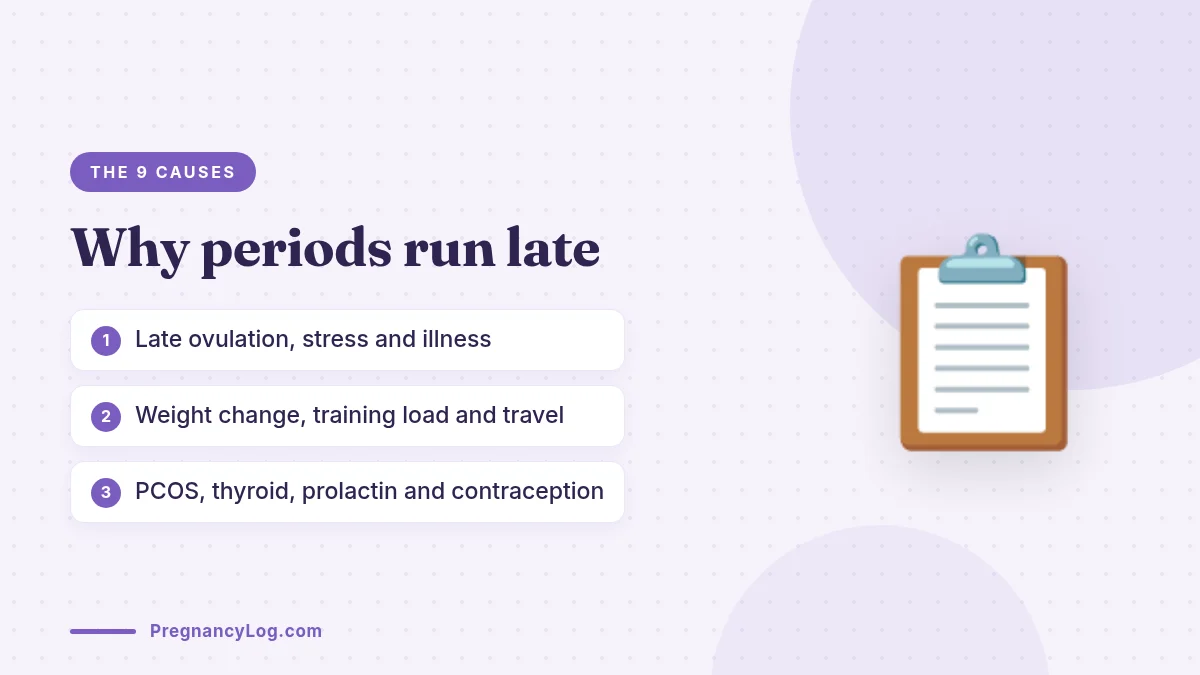
1. You ovulated later than usual
The single most common explanation. Your luteal phase (ovulation to period) is fairly fixed at 12–14 days, but the first half of the cycle varies a lot. Late ovulation pushes the period back by exactly as many days.
2. Stress
Emotional or physical stress raises cortisol, which suppresses the hormone signals that trigger ovulation. Exam periods, bereavement, a house move or intense work stretches routinely delay periods by days to weeks.
3. Illness
A viral infection, fever, food poisoning or COVID-19 in the first half of your cycle can delay ovulation. The period arrives late even though nothing is wrong.
4. Weight change, dieting or heavy training
Rapid weight loss, being significantly under- or overweight, and high training volumes can all suppress ovulation. Athletes and people in a large calorie deficit commonly have late or absent periods.
5. Sleep disruption, shift work and travel
Circadian disruption affects the hypothalamus directly. Night shifts and long-haul travel across time zones are well-recognised causes of a delayed cycle.
6. Polycystic ovary syndrome (PCOS)
PCOS is the most common cause of chronically irregular or unpredictable cycles, often alongside acne, excess hair growth or difficulty conceiving. The NHS overview of PCOS lists the typical pattern.
7. Thyroid problems
Both an underactive and an overactive thyroid disrupt cycles. Look for fatigue, cold or heat intolerance, weight change, hair thinning or palpitations — a simple thyroid blood test settles it.
8. Contraception, medication changes and breastfeeding
Starting, stopping or switching hormonal contraception commonly shifts cycles for a few months. Emergency contraception can delay a period by up to a week. Antipsychotics, some antidepressants, steroids, chemotherapy and thyroid medication all affect timing. Breastfeeding suppresses cycles for months — see no period after pregnancy: when to worry.
9. Raised prolactin, perimenopause or other conditions
High prolactin (from medication or, rarely, a benign pituitary tumour), perimenopause from the late thirties onwards, uncontrolled diabetes, coeliac disease and chronic inflammatory conditions can all delay or stop periods. NHS guidance on stopped or missed periods covers the full list and the order of investigation.
How and When to Retest for a Definite Answer
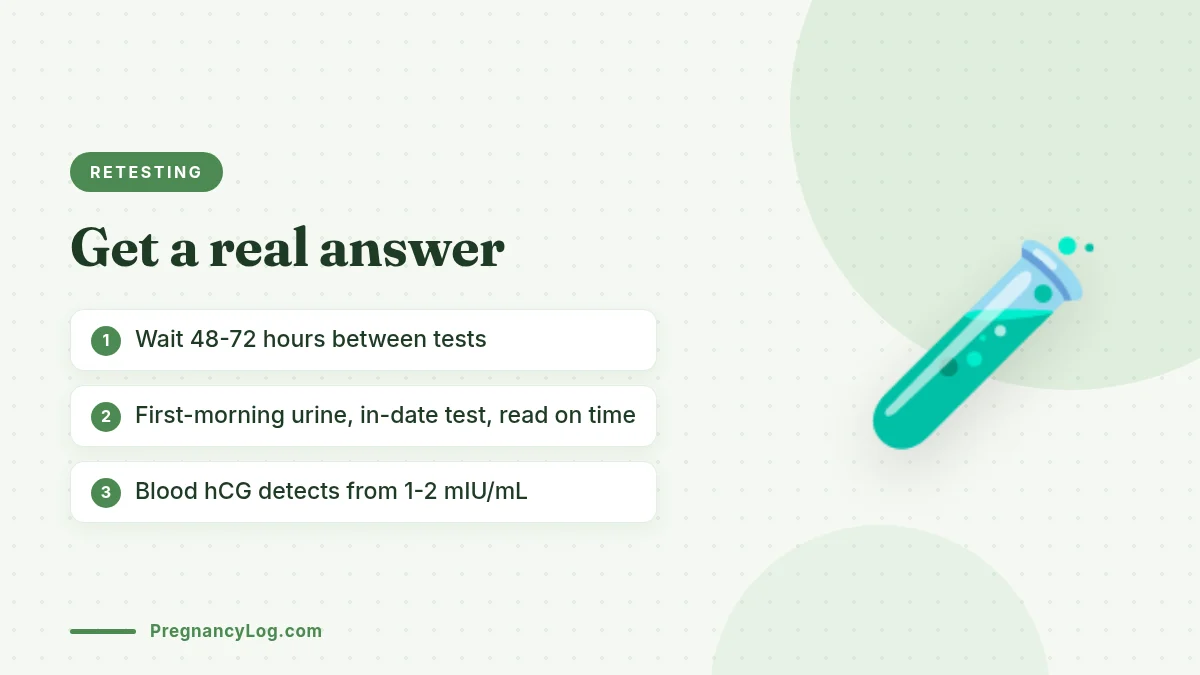
- Wait 48–72 hours before retesting. hCG needs that long to double meaningfully. Testing daily tells you nothing new and costs a fortune in anxiety.
- Use first-morning urine. It is the most concentrated of the day. Avoid drinking large amounts of water in the hours before.
- Check the test itself. In date, stored at room temperature, sealed until use. A sensitivity of 10–12.5 mIU/mL (“early result”) is better than 25 mIU/mL at this stage.
- Read it at the stated time — usually 3–5 minutes. Lines appearing after 10 minutes are evaporation lines, not positives. Our faint line guide shows what counts.
- Ask for a quantitative blood hCG if you want certainty now. It detects from about 1–2 mIU/mL and gives an exact number; repeated after 48 hours it shows whether a pregnancy is progressing.
- If you suspect late ovulation, count 14 days forward from any ovulation signs you noticed (fertile-quality discharge, mid-cycle twinge, positive ovulation test) and test then instead of counting from your missed period.
Two negative tests 72 hours apart with first-morning urine, at four or more days late, make pregnancy very unlikely. At that point the question becomes why your period is late, not whether you are pregnant. For the timing maths earlier in the cycle, see our 10 DPO negative test and 12 DPO test guides.
When to See a Doctor About a Late Period
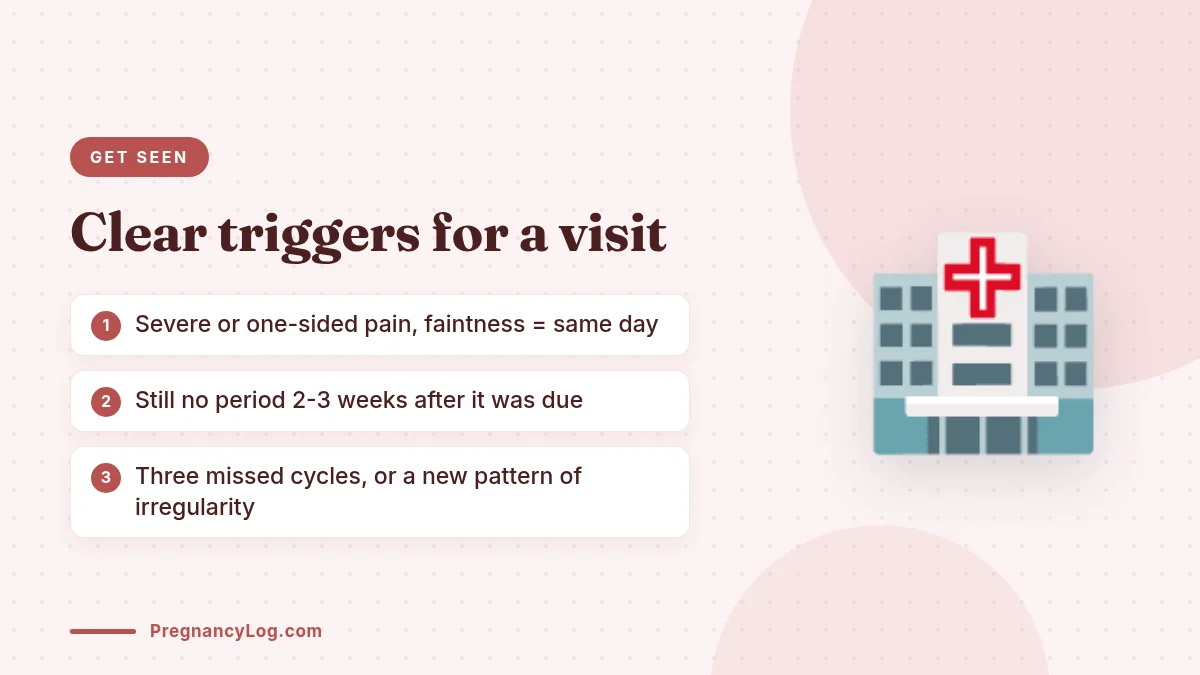
Same-day care if you have any of these, whatever your test says:
- Severe or one-sided pelvic pain, or shoulder-tip pain
- Dizziness, fainting, or a racing heart
- Heavy bleeding soaking a pad in an hour, or large clots
- Fever with pelvic pain or foul-smelling discharge
Book a routine appointment if:
- Your period is 2–3 weeks late and tests are still negative
- You have missed three cycles in a row, or three in six months
- Cycles have become consistently irregular, very heavy, or under 21 or over 35 days
- You have symptoms suggesting a hormonal cause: fatigue, temperature intolerance, hair loss or excess hair growth, acne, nipple discharge, headaches, vision changes, hot flushes
- You have been trying to conceive for 12 months (or 6 months if you are over 35)
Expect a straightforward work-up: a repeat pregnancy test, then blood tests for thyroid function, prolactin, FSH, LH and oestradiol, and a pelvic ultrasound if cycles are irregular. Most causes found at this stage are simple and manageable. If the wait itself is the hardest part, our step-by-step pregnancy scare guide lays out the practical order of things.
What to Do While You Wait
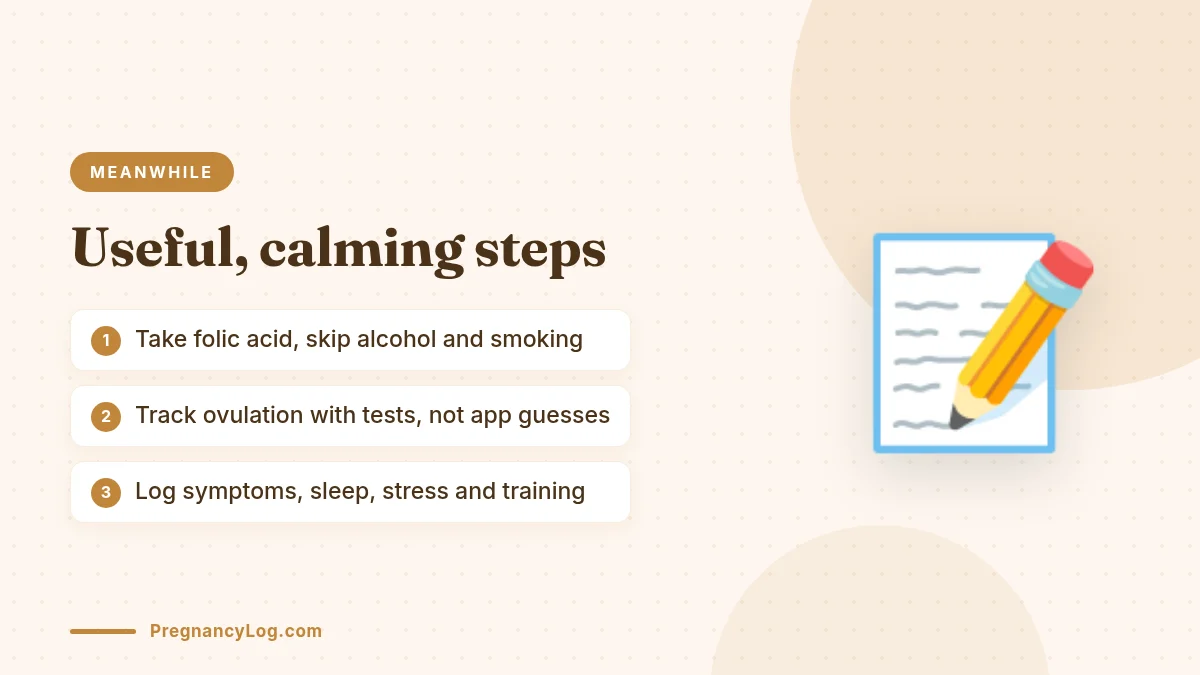
Until you know, treat yourself as possibly pregnant. That means 400 µg of folic acid daily, no alcohol, no smoking or vaping, caffeine under about 200 mg a day, and checking any medication or supplement with a pharmacist. None of this is wasted if the test turns out negative.
Then make the next cycle easier to interpret:
- Track ovulation directly. Ovulation predictor kits detect the LH surge 24–36 hours before ovulation; basal body temperature confirms it afterwards. Both beat app predictions.
- Log the whole picture — cycle length, spotting, sleep, illness, training load, travel and stress. Patterns become obvious over three months and are genuinely useful at an appointment.
- Protect sleep and reduce load where you can. Late ovulation caused by stress and sleep debt is real physiology, not a moral failing.
- Do not stack tests. Two well-timed tests beat seven badly timed ones.
If your next test turns positive, our free due date calculator will give you your due date and current week straight away.
Frequently Asked Questions
Can I still be pregnant with a negative test 4 days after my period was due?
It is possible but uncommon roughly a 1 in 100 chance if your ovulation timing was as expected. The main exception is late ovulation: if you ovulated a week later than usual, you may only be 11 DPO rather than 18, and hCG can still be below the detection threshold. Retest with first-morning urine in 48 to 72 hours, or ask for a blood hCG.
How late can a period be without being pregnant?
A variation of a few days either side is normal, and one late or skipped cycle a year happens to most people. Delays of one to two weeks from stress, illness, travel or late ovulation are common. Missing three cycles in a row, or three in six months, is the point at which it should always be investigated.
Does testing in the evening cause a false negative?
It can. Urine is more dilute later in the day, especially if you have been drinking plenty of fluid, so hCG concentration drops. At four days late a well-established pregnancy will usually still show up, but first-morning urine is the reliable choice for a decisive result.
Can stress alone delay my period by 4 days?
Easily. Stress raises cortisol, which suppresses the hormone pulses that trigger ovulation, and any delay in ovulation delays the period by the same number of days. Four days is a very typical stress-related shift, and cycles usually normalise within a month or two.
I have cramps and sore breasts but a negative test. What does that mean?
Premenstrual symptoms and early pregnancy symptoms are driven by the same hormone, progesterone, so they feel almost identical. Cramping and breast tenderness cannot distinguish between the two. Retest in 48 to 72 hours, and watch for one-sided or severe pain, which needs same-day assessment.
Should I take a blood test instead of another home test?
If you need certainty quickly, yes. A quantitative blood hCG detects from about 1 to 2 mIU/mL, gives an exact number rather than a yes or no, and can be repeated after 48 hours to show whether levels are rising. It is the fastest way to end the uncertainty.
The Bottom Line
At four days late, a negative home test taken with first-morning urine is right about 99% of the time. The main thing that breaks that accuracy is ovulating later than you thought — which is exactly why late ovulation, stress and illness dominate the list of causes.
Do this: retest once in 48–72 hours with morning urine and an in-date test. If it is still negative, pregnancy is very unlikely and the question becomes why your cycle is late. Book an appointment if your period is 2–3 weeks overdue, you have missed three cycles, or you have symptoms pointing at thyroid, prolactin or PCOS — and get same-day care for severe pain, faintness or heavy bleeding.
Watch: My Period Is 6 Days Late, but 3 Pregnancy Tests Say Negative. What’s H
Watch this helpful video to learn more about a 4 days late negative pregnancy test.