
No period after pregnancy is one of the most common questions in the first postpartum year — and one of the hardest to get a straight answer to, because “normal” covers an enormous range. Some people bleed again at six weeks. Some breastfeeding parents go 14 months without a single cycle and are completely healthy.
This guide gives you the actual thresholds: how long is genuinely normal depending on how you are feeding your baby, the nine reasons a postpartum period stays away, the red flags that need a call today, and the tests a doctor will run if your cycle is late enough to investigate. If you want the full month-by-month picture, our companion guide on when your period returns after pregnancy walks through what the first cycles usually look like.
One important note up front: you can ovulate — and conceive — before your first postpartum period arrives.
When Is No Period After Pregnancy Still Normal?
For the broader postpartum recovery topic, see the postpartum recovery hub and this guide for late or absent periods.
For the complete symptom index, see the pregnancy symptoms guide.
For related symptom explainers and safe next-step guidance, browse the Pregnancy Health hub.
Postpartum bleeding (lochia) is not a period. It lasts up to about six weeks and tapers from red to pink to brown to cream. Your first true period is the bleed that comes after lochia has fully stopped and your cycle restarts.
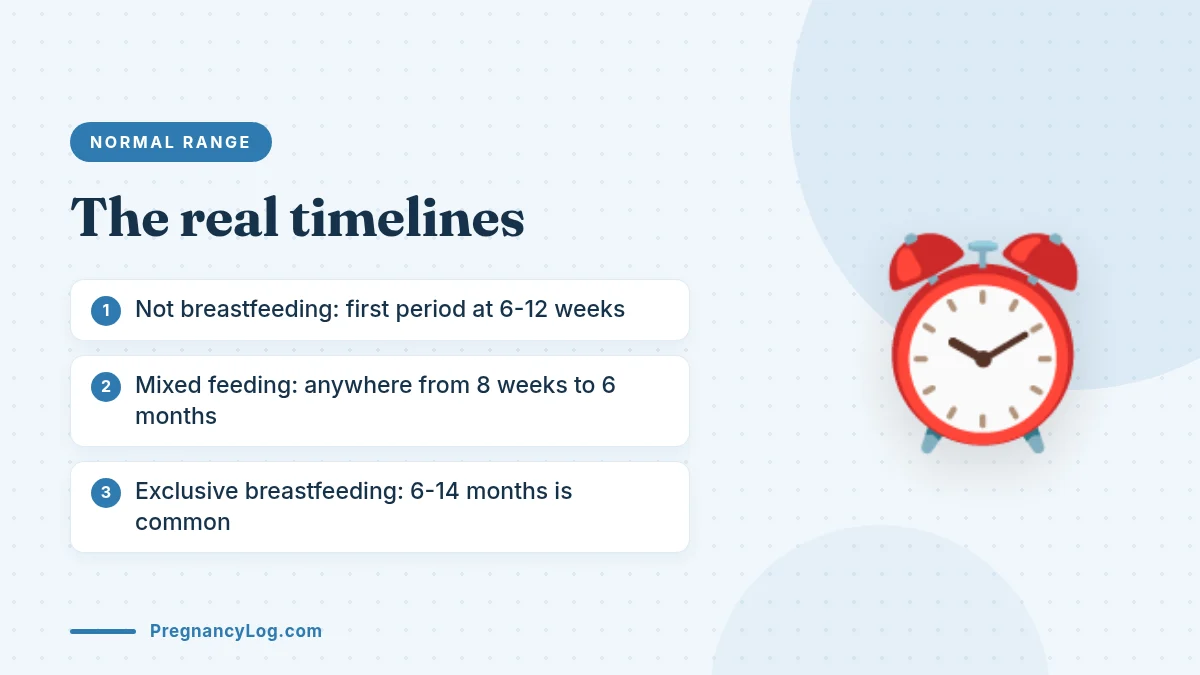
If you are not breastfeeding at all, ovulation typically restarts around 6 weeks and the first period arrives between 6 and 12 weeks after birth. Up to about 3 months is unremarkable.
If you are combination feeding, timing depends on how much your baby breastfeeds. Anywhere from 8 weeks to 6 months is normal, and the period often returns soon after you drop night feeds or start solids.
If you are exclusively breastfeeding on demand, day and night, frequent suckling keeps prolactin high, which suppresses the hormones that trigger ovulation — lactational amenorrhoea. Going 6 to 14 months without a period is completely normal, and some people do not menstruate until they stop breastfeeding entirely. ACOG notes this is expected physiology, not a problem to fix.
After a caesarean, a miscarriage or a termination, the same rules apply: the clock runs from the end of the pregnancy, not from any particular type of birth.
No Period After Pregnancy: When to Worry
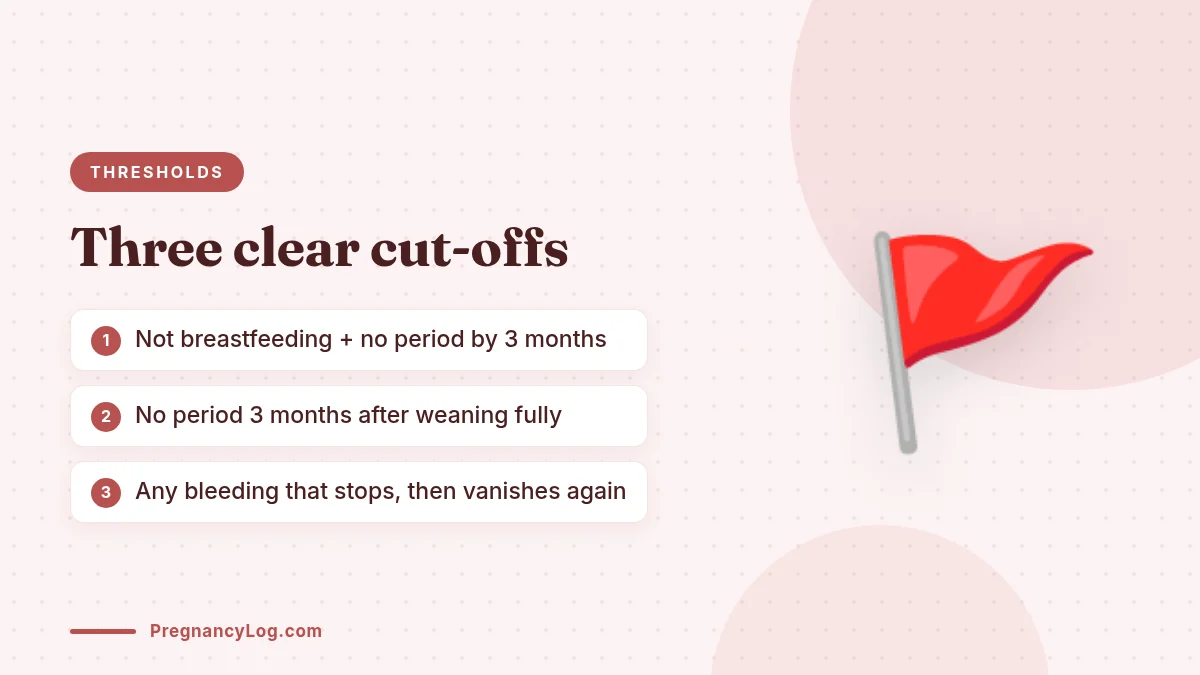
Use these thresholds rather than guessing:
- Not breastfeeding and no period by 12 weeks (3 months) after birth — book a check-up.
- Breastfeeding, but no period 3 months after you have fully weaned — book a check-up.
- Breastfeeding only a couple of times a day, or night-weaned for 3+ months, with no period — worth mentioning at your next appointment.
- Your period returned and then disappeared again for 3 months or more (secondary amenorrhoea) — this needs assessing whatever your feeding situation.
- Any missing period plus a red flag symptom from the section below — do not wait for a threshold.
The single most important first step at any of those points is a pregnancy test. Conception in the first postpartum year is extremely common precisely because people assume no period means no fertility. Ovulation can return before your first bleed, and it can return during breastfeeding as soon as feeds space out. If your test is faint or ambiguous, our guide to a faint line on a pregnancy test explains how to read it, and a negative test at 10 DPO covers testing too early.
Also remember that hormonal contraception is a legitimate reason to have no periods at all. The progestogen-only pill, the implant, the hormonal IUD and especially the contraceptive injection frequently stop bleeding completely — that is a known effect, not a warning sign. ACOG’s postpartum birth control guidance and Planned Parenthood both cover which methods are used while breastfeeding.
9 Reasons Your Period Has Not Returned After Birth
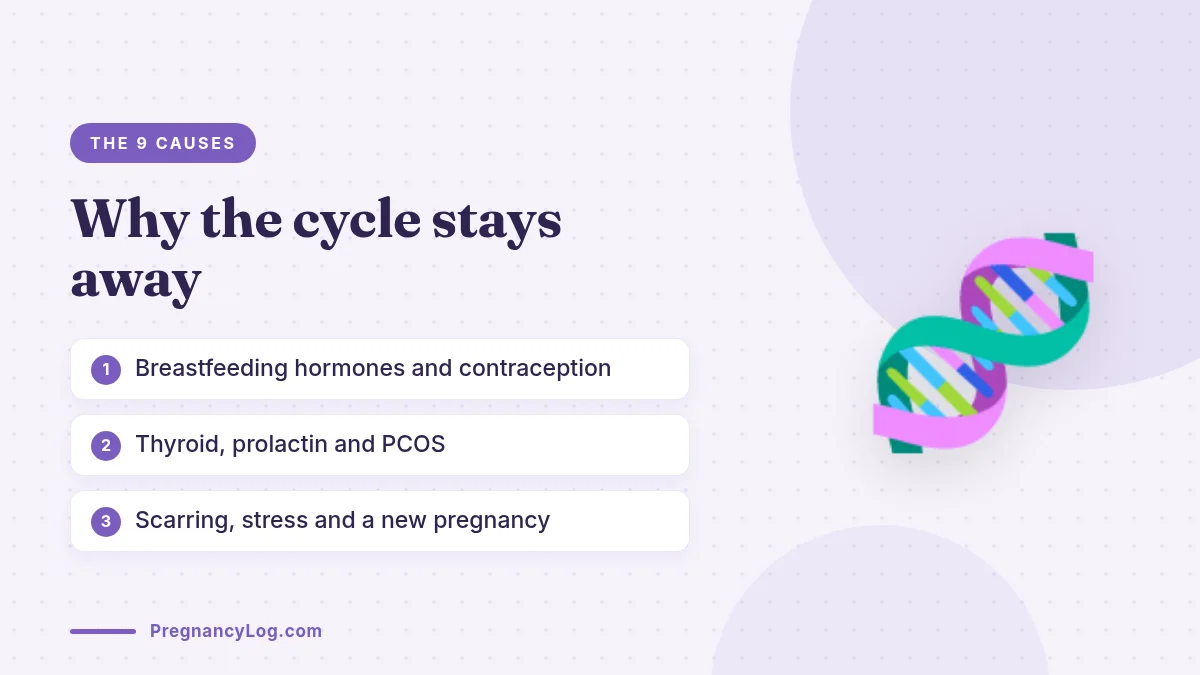
1. Lactational amenorrhoea (breastfeeding)
The number one cause. Frequent suckling raises prolactin, which suppresses GnRH and stops ovulation. The more often and the longer you feed — especially overnight — the longer periods stay away.
2. You are pregnant again
Common and easily missed. Test before assuming anything else, even if you are breastfeeding and even if you have used contraception.
3. Hormonal contraception
The depot injection stops bleeding in up to half of users after a year, and the hormonal IUD, implant and progestogen-only pill all commonly cause absent periods. Nothing needs fixing unless you want your cycle back.
4. Thyroid problems
Postpartum thyroiditis affects roughly 5% of people and can cause an overactive then underactive phase. Absent periods with fatigue, weight change, hair loss, feeling cold or constipation should trigger a thyroid test — see NHS guidance on an underactive thyroid.
5. High prolactin from another cause
If you are not breastfeeding but still have milky nipple discharge, headaches or vision changes, prolactin can be raised by medication (some antipsychotics, antidepressants and anti-sickness drugs) or, rarely, a benign pituitary tumour called a prolactinoma. Both are treatable.
6. Polycystic ovary syndrome (PCOS)
PCOS often shows itself again after birth with irregular or absent cycles, acne and excess hair growth. It is the most common cause of ovulatory problems in people who are not breastfeeding — read the NHS PCOS overview.
7. Intrauterine adhesions (Asherman’s syndrome)
Scar tissue inside the uterus can form after a D&C for retained placenta or heavy postpartum bleeding, and it can stop periods entirely or make them very light. It is uncommon but important, because it is treatable and affects future fertility.
8. Very low body weight, heavy exercise or high stress
Severe calorie deficit, intense training or extreme sleep deprivation can suppress the hypothalamus and stop ovulation (functional hypothalamic amenorrhoea). New parenthood delivers all three at once, so this is more common than people expect.
9. Rare pituitary and ovarian causes
Sheehan’s syndrome — pituitary damage after severe postpartum haemorrhage — can cause absent periods along with fatigue, low blood pressure and difficulty breastfeeding. Premature ovarian insufficiency is also possible, particularly with hot flushes and night sweats. Both are rare, both need blood tests, and neither should be self-diagnosed.
Red Flags That Need a Doctor Now
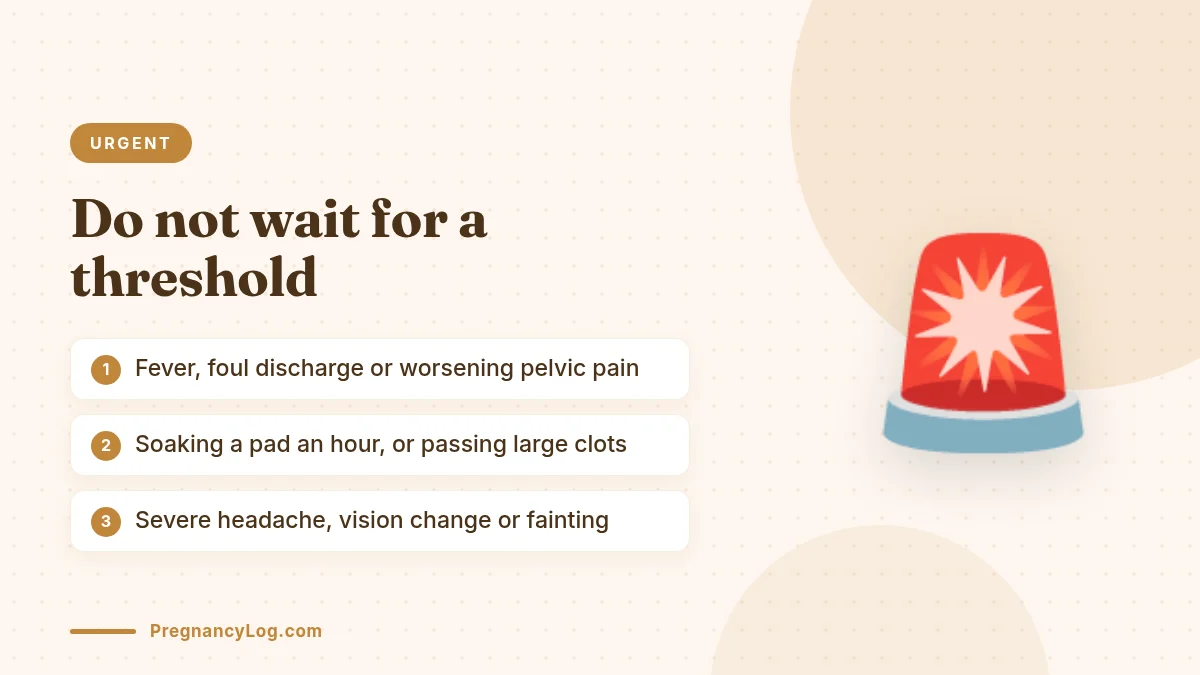
Seek same-day medical care if a missing period comes with any of these:
- Fever, chills, or foul-smelling vaginal discharge — possible endometritis or retained products of conception
- Bleeding that soaks a pad in an hour, or clots bigger than a golf ball — postpartum haemorrhage can occur weeks after birth
- Severe or persistent headache, blurred vision, or fainting — needs blood pressure and pituitary assessment
- New pelvic pain that is worsening, or pain with sex that started after birth
- Milky discharge when you are not breastfeeding, especially with headaches or vision changes
- Extreme fatigue, dizziness, breathlessness or palpitations — postpartum anaemia and thyroid disease both present this way
- Signs of severe depression or anxiety, or thoughts of harming yourself — urgent, and unrelated to the period question but far more important
Blood pressure remains worth checking in the postpartum weeks too: pre-eclampsia can appear or persist after delivery. If you had heavy blood loss at birth, ask for a full blood count — iron deficiency is common and treatable, and it can also delay cycles returning.
How Doctors Investigate a Missing Postpartum Period
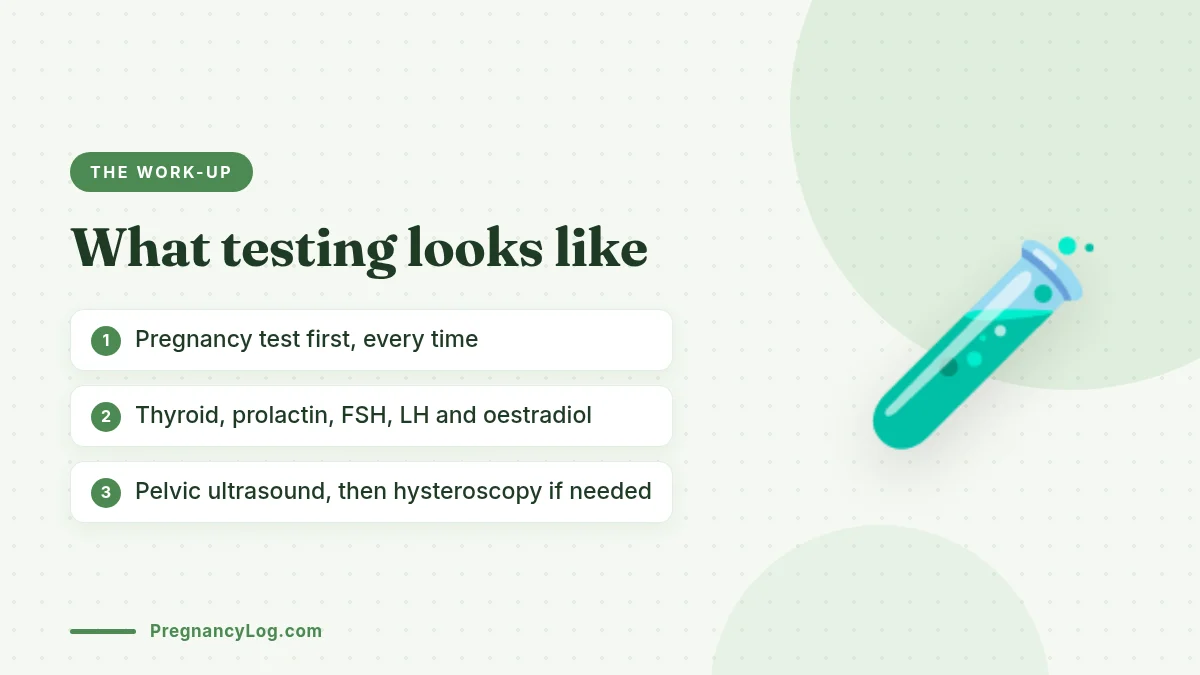
The work-up is quick, non-invasive and usually done at primary care level:
- Urine or blood pregnancy test. Always the first step.
- History and feeding review. How often the baby feeds, whether you feed overnight, contraception, medications, blood loss at delivery, any D&C, weight changes and stress.
- Blood tests: thyroid function (TSH, free T4), prolactin, FSH, LH and oestradiol, plus a full blood count and ferritin if you lost significant blood. NHS guidance on stopped or missed periods follows the same order.
- Pelvic ultrasound to look at the endometrium and ovaries and to rule out retained products.
- Hysteroscopy only if adhesions are suspected — usually after a D&C, very light periods or infertility.
- Pituitary MRI reserved for high prolactin with headaches or visual symptoms.
What treatment looks like: nothing at all if breastfeeding is the cause; thyroid hormone replacement for hypothyroidism; dopamine agonists for a prolactinoma; weight, nutrition and training adjustments for hypothalamic amenorrhoea; hysteroscopic surgery for adhesions; and a discussion about contraception if a hormonal method is simply doing its job. Iron replacement is worth asking about — postpartum anaemia is common and, along with sleep debt, one of the reasons recovery drags. Our guide to breast and nipple changes in pregnancy and breastfeeding covers another symptom that often overlaps this period.
Frequently Asked Questions
Can I get pregnant if my period has not returned after birth?
Yes. Ovulation can restart before your first bleed, sometimes as early as 5 to 6 weeks postpartum if you are not breastfeeding. Exclusive, on-demand breastfeeding day and night in the first 6 months suppresses ovulation for most people, but it is not reliable contraception once feeds space out, solids begin or your baby sleeps through. Use a method you have discussed with your midwife or doctor if you do not want to conceive again yet.
How long can breastfeeding delay my period?
Anywhere from a few months to well over a year. Six to fourteen months is common with frequent feeding, and some parents do not menstruate until several weeks after weaning completely. Periods usually return once night feeds stop, solids are established or feeds drop to a few a day.
I am not breastfeeding and still have no period at 4 months. Is that a problem?
It is worth investigating. Take a pregnancy test first, then book an appointment for thyroid and prolactin blood tests. Four months without a period in someone who is not breastfeeding is outside the usual range, but the causes found are typically simple and treatable.
Is it normal for my first postpartum period to be very heavy or irregular?
Yes. The first few cycles are often heavier, longer, more clotty or unpredictable while ovulation settles down, and cramps can be worse than before pregnancy. Soaking a pad an hour, passing very large clots or bleeding beyond 7 to 10 days is not normal and needs review.
Does a caesarean or a difficult birth delay periods?
The type of birth does not directly change when your cycle restarts — feeding pattern does. However, heavy blood loss, a D&C for retained placenta, severe anaemia or significant illness can all delay things, and adhesions after uterine surgery are one specific cause of absent periods worth ruling out.
Should I take a pregnancy test even while breastfeeding?
Yes, and it is accurate. Breastfeeding does not affect hCG or pregnancy test results. If you have any concern about a new pregnancy — sore breasts, nausea, fatigue that is worse than usual — test, and repeat in a week if the result is negative but symptoms continue.
The Bottom Line
No period after pregnancy is usually your body doing exactly what it is meant to: prolactin from breastfeeding keeps ovulation switched off, or a hormonal contraceptive is quietly doing its job. Six to twelve weeks is typical without breastfeeding, and six to fourteen months with it.
The thresholds worth acting on are simple. No period by three months when you are not breastfeeding, no period three months after fully weaning, or a cycle that returns and then vanishes for three months all deserve a pregnancy test and a set of blood tests. Add any red flag — fever, foul discharge, heavy bleeding, severe headaches, milky discharge without breastfeeding, or crushing fatigue — and the timeline no longer matters. Get seen.
Watch: Periods After Pregnancy: What to Expect and When
Watch this helpful video to learn more about no period after pregnancy.
About the Author
The PregnancyLog Editorial Team researches and writes every guide on PregnancyLog.com. We build our articles from guidance published by bodies such as the American College of Obstetricians and Gynecologists (ACOG), the NHS, MedlinePlus and the National Institutes of Health, and we review each page for accuracy as new guidance appears. This article is for general information only and is not a substitute for personal medical advice. Always speak to your midwife, doctor or pharmacist about your own pregnancy. Questions or corrections? Contact us.