
introduction
For the complete testing sequence, see the pregnancy test guide before choosing another test.
For more timing, result, and retesting guidance, browse the full pregnancy testing hub.
You had a few days of light pink or brown spotting, the timing looked exactly like implantation bleeding, and you were sure this was it. Two weeks later the tests are still stark white. An implantation bleeding negative pregnancy test combination is confusing precisely because the two things should not normally coexist for long.
Here is the key fact that shapes everything below: implantation happens 6–12 days after ovulation, and hCG roughly doubles every 48–72 hours from then. Two weeks after genuine implantation, hCG in a healthy pregnancy is usually in the hundreds or thousands of mIU/mL — far above the 20–25 mIU/mL that a standard home test detects. So a negative test at that point is a real signal, not just bad timing.
This guide covers what that signal usually means: the seven explanations in order of likelihood, the tests that settle it, and the symptoms that need urgent care rather than another stick.
Was It Really Implantation Bleeding?
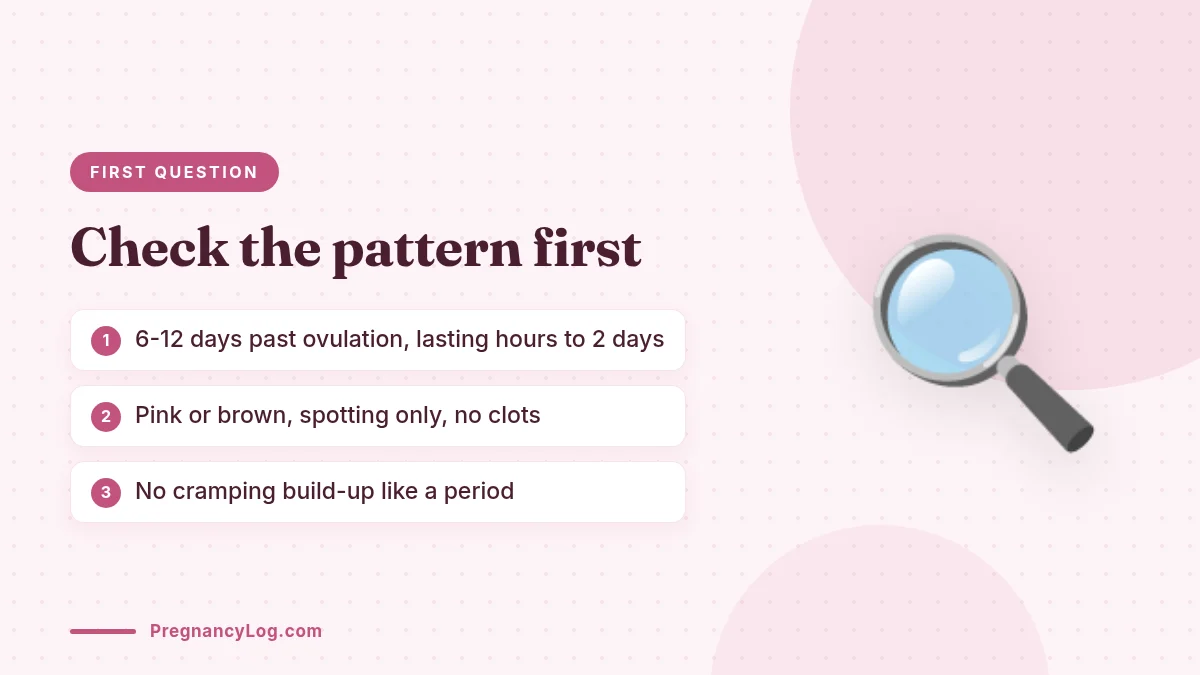
Implantation bleeding is far less common than the internet suggests most people who conceive never see any. When it does happen it has a recognisable pattern:
- Timing: 6–12 days past ovulation (DPO), so usually a few days before your period is due
- Amount: spotting only — enough for a liner, never a pad or tampon
- Colour: light pink or rusty brown rather than fresh red
- Duration: a few hours up to two days, often intermittent
- Clots: none
- Pain: mild twinges at most, without the escalating cramps of a period
Things that get mistaken for implantation bleeding: ovulation spotting (mid-cycle, around 14 days before your next period), breakthrough bleeding on hormonal contraception, spotting after sex or a smear from a sensitive cervix, a short or light period, bleeding from an infection such as chlamydia or bacterial vaginosis, a fibroid or polyp, and stress- or thyroid-related cycle disruption.
If your spotting was heavier, redder, lasted longer than two days, or arrived when your period was due, the most likely explanation is simply that it was a light period — which fits perfectly with negative tests. Our guides to testing at 9 DPO and 12 DPO explain how the timing maths works.
Why 2 Weeks After Implantation Bleeding Changes the Answer
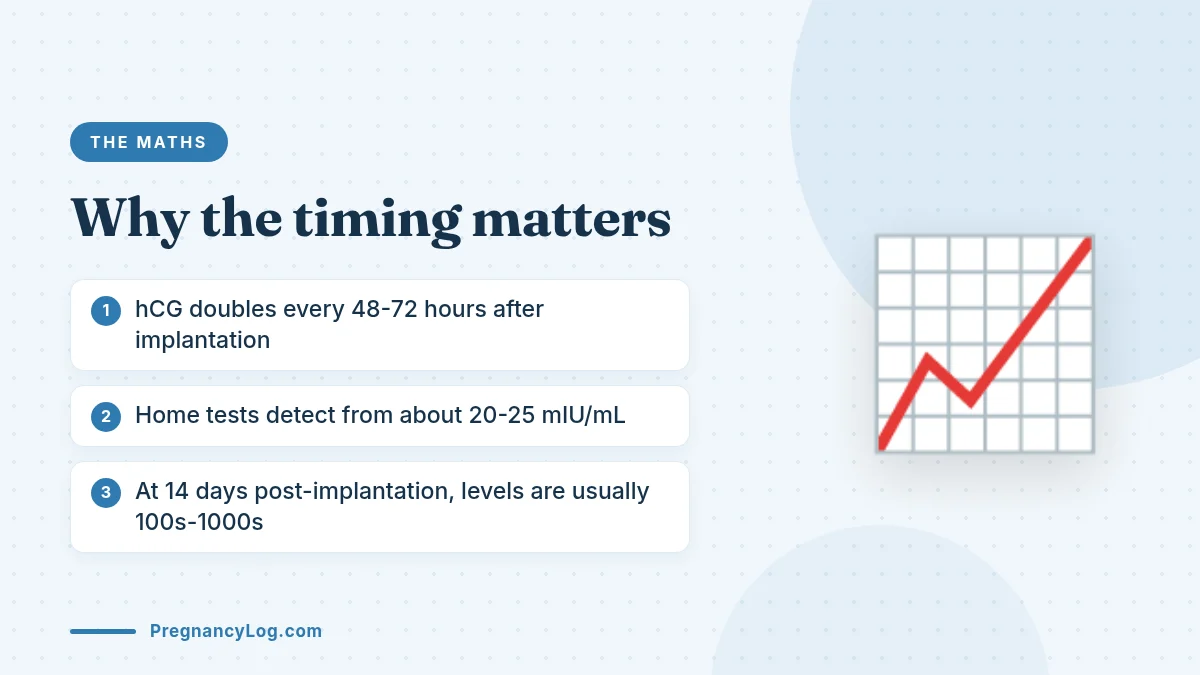
A negative test three days after spotting means very little — hCG may simply be too low to detect. A negative test two weeks after spotting is a different story.
Working from real numbers: hCG becomes detectable in urine roughly 3–4 days after implantation. It then doubles every 48–72 hours through the first weeks. Even from a low starting point of 5 mIU/mL, fourteen days of doubling produces a level well into the hundreds. Standard home tests trigger at 20–25 mIU/mL; early-result tests at 6.5–12.5 mIU/mL. MedlinePlus and the NHS both note that tests are considered reliable from the day a period is due.
So if genuine implantation happened two weeks ago and the pregnancy is developing normally, a home test taken with reasonably concentrated urine should be positive — usually strongly positive. When it is not, one of the seven explanations below applies.
One caveat worth knowing: dilution. Drinking a lot of water before testing can drop urine hCG below the threshold even at reasonable blood levels. Always retest with first-morning urine before drawing conclusions.
7 Causes of a Negative Test After Implantation Bleeding
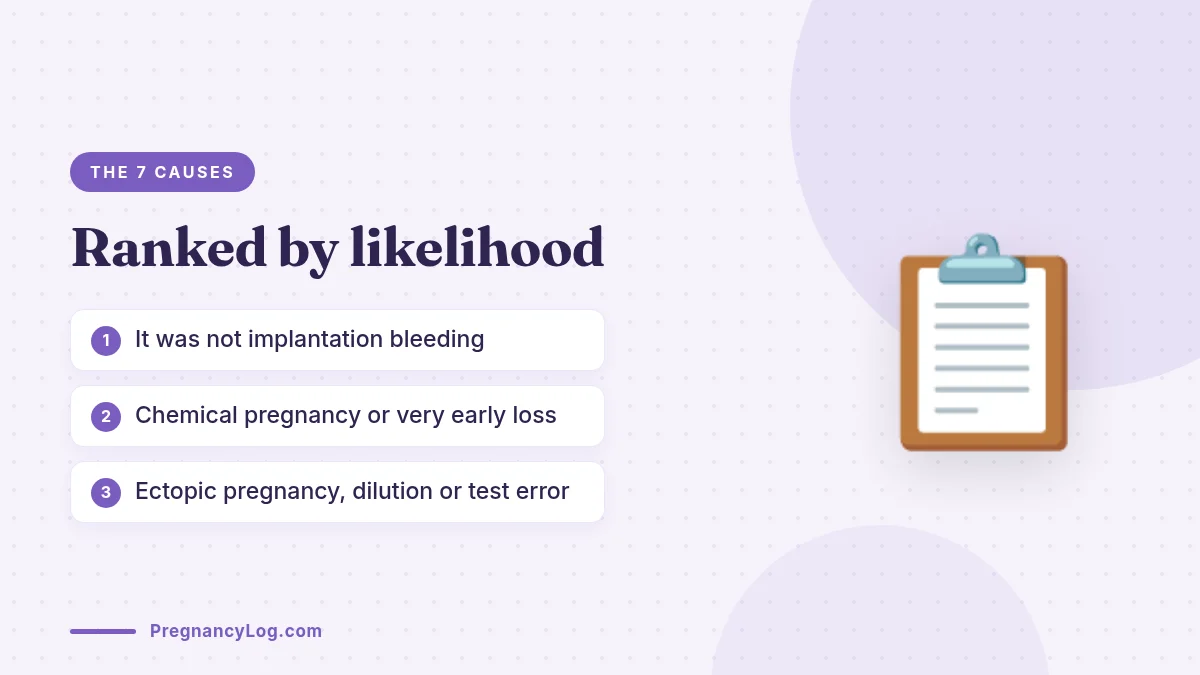
1. The bleeding was not implantation bleeding
The most common answer by a wide margin. Ovulation spotting, a light period, breakthrough bleeding, post-sex spotting or an infection can all look the part. If tests stay negative and your next period arrives on time, this is almost certainly what happened.
2. A chemical pregnancy (very early miscarriage)
An embryo implanted, produced enough hCG to cause spotting, and then stopped developing. hCG rises briefly and falls again, so tests that might have been faintly positive a week ago are negative now, and a period-like bleed follows. Chemical pregnancies are thought to account for a large share of all conceptions and usually need no treatment — but they are worth mentioning to your doctor, especially if they repeat.
3. You ovulated later than you thought
If ovulation was a week later than assumed, what you counted as implantation bleeding at “10 DPO” may have been mid-cycle spotting, and true implantation may not have happened yet. Cycle apps predict; they do not measure. Ovulation tests or basal temperature tracking give real dates.
4. Diluted urine or user error
Testing in the afternoon after lots of fluid, reading the result outside the stated window, using a test that was stored in a hot car or reading a very faint line under bad light all cause false negatives. Use first-morning urine, read at the stated time, and check the expiry date — see our guide to whether pregnancy tests can expire.
5. Ectopic pregnancy
An embryo implanted outside the uterus, usually in a fallopian tube. hCG often rises slowly, so tests can be negative, faint or slow to darken while spotting continues. Ectopic pregnancy is a medical emergency if the tube ruptures, so one-sided pelvic pain, shoulder-tip pain, dizziness or faintness with spotting means same-day assessment, regardless of what the test says.
6. A very low or slowly rising hCG for another reason
Miscarriage in progress, a blighted ovum or an unusual implantation site can all produce lower-than-expected hCG. Only a quantitative blood test and, if needed, an ultrasound can distinguish these.
7. Rare test-level explanations
The “hook effect” (extremely high hCG saturating the test) is genuinely rare and mostly relevant in molar or multiple pregnancy well past this stage. Certain fertility drugs containing hCG can cause false positives rather than negatives, and biotin or diuretics can distort some results. These are footnotes, not likely answers.
If this cycle has been stressful, our step-by-step guide for a pregnancy scare is a calmer way through it.
What to Do Now: A 5-Step Plan
 Retest with first-morning urine, then ask for a quantitative blood hCG if anything is unclear.
 Retest with first-morning urine, then ask for a quantitative blood hCG if anything is unclear.
- Retest properly. First-morning urine, a fresh in-date test from a different batch or brand, read at exactly the stated time. Do not drink extra water beforehand.
- Ask for a quantitative blood hCG (beta hCG). It measures the exact number rather than pass/fail, detects from about 1–2 mIU/mL, and a repeat 48 hours later shows whether levels are rising, plateauing or falling. This single test answers the question that home kits cannot.
- Log the bleeding. Note dates, colour, volume, clots and pain each day. If it turns into a normal period, you have your answer. If spotting continues for more than a few days without a period, that needs review.
- Get seen urgently for any of these: one-sided or severe pelvic pain, shoulder-tip pain, dizziness, fainting, heavy bleeding soaking a pad an hour, fever, or feeling generally very unwell. These can indicate ectopic pregnancy or infection — ACOG’s guidance on bleeding in early pregnancy explains why speed matters.
- If your period does not arrive within a week of the expected date and tests stay negative, book an appointment. A missed period with negative tests has its own list of causes — thyroid problems, PCOS, high prolactin, stress and weight change — and all are easy to test for.
Meanwhile, keep taking folic acid, avoid alcohol and smoking, and treat yourself as possibly pregnant until you know. Our 10 DPO negative test guide and the faint line explainer both help with reading borderline results, and the due date calculator is there if the next test turns positive.
When a Negative Test Really Means Not Pregnant
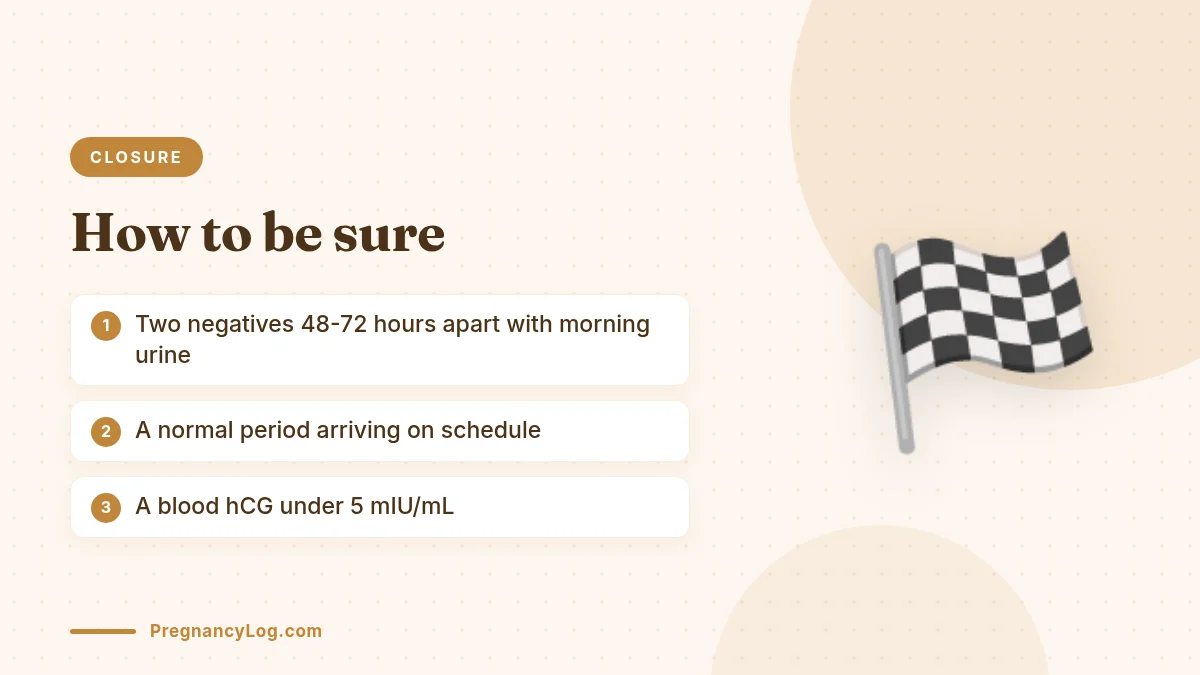
You can be confident you are not currently pregnant when all of these line up: two negative tests taken 48–72 hours apart with first-morning urine, a blood hCG below 5 mIU/mL, and a period that arrives roughly on schedule. Three weeks of negatives after the spotting episode is conclusive for a viable pregnancy.
At that point the useful question changes from “am I pregnant?” to “what caused the spotting?” Worth investigating if it repeats: hormonal contraception adjustment, a cervical polyp or ectropion, fibroids, infection screening (chlamydia, gonorrhoea, bacterial vaginosis), thyroid function, prolactin, and PCOS if cycles are irregular. Mid-cycle spotting once is usually nothing; a pattern deserves an explanation.
If you are trying to conceive, this is also the moment to switch from guesswork to data: ovulation predictor kits or temperature tracking to confirm when you actually ovulate, sex in the fertile window rather than on app predictions, and a review with your doctor after 6–12 months of trying (sooner if you are over 35, have irregular cycles, or have had recurrent early losses).
Frequently Asked Questions
How long after implantation bleeding should a pregnancy test be positive?
Usually within 3 to 4 days, and almost always within a week. hCG becomes detectable in urine a few days after implantation and doubles every 48 to 72 hours, so by two weeks after genuine implantation bleeding a home test should be clearly positive if the pregnancy is developing normally.
Can you have implantation bleeding and not be pregnant?
You cannot have true implantation bleeding without an implanting embryo — but you can absolutely have spotting that looks identical without being pregnant. Ovulation spotting, breakthrough bleeding, cervical irritation, infection, polyps and a light period are all far more common than implantation bleeding.
Would a blood test pick up a pregnancy my urine test missed?
Yes. A quantitative blood hCG detects levels from about 1 to 2 mIU/mL, compared with 20 to 25 mIU/mL for most home tests, and gives you an exact number. Two blood tests 48 hours apart show whether hCG is rising normally, which is the fastest way to identify a chemical pregnancy or a possible ectopic.
Is a chemical pregnancy something I need treatment for?
Usually not. A chemical pregnancy typically resolves like a slightly late, slightly heavier period and does not require intervention. See your doctor if bleeding is very heavy, you have fever or severe pain, hCG does not fall, or you have had two or more early losses — recurrent loss deserves investigation.
Could this be an ectopic pregnancy with negative tests?
It is possible but uncommon: ectopic pregnancies usually produce some hCG, so tests are more often faintly positive than fully negative. What matters is the symptoms. One-sided pelvic pain, shoulder-tip pain, dizziness, fainting or heavy bleeding needs same-day assessment whatever your test shows.
Should I keep testing every day?
No. Daily testing wastes money and raises anxiety without adding information, because hCG needs 48 hours to change meaningfully. Test with first-morning urine every 2 to 3 days at most, or ask for a blood test to get a definite answer.
The Bottom Line
Two weeks is long enough for the numbers to speak. If implantation genuinely happened, hCG would normally be far above the threshold of any supermarket test by now — so a clear negative usually means either the spotting was something else entirely, or an early pregnancy stopped developing before it could establish.
Do three things: retest once with first-morning urine, ask for a quantitative blood hCG if there is any doubt, and treat one-sided pain, shoulder-tip pain, dizziness or heavy bleeding as an emergency regardless of the test result. If your period arrives on time and tests stay negative, you have your answer — and if spotting keeps happening between periods, that is worth its own appointment.
Watch: Implantation Bleeding and False Negative Early Pregnancy Test
Watch this helpful video to learn more about implantation bleeding with a negative pregnancy test.