
introduction
You took the test, waited the longest three minutes of your life, and now you’re squinting at a faint line on a pregnancy test, trying to decide if it counts as positive. This is one of the most common — and most anxiety-inducing — moments in early pregnancy testing, and you’re far from alone in wondering what it means.
The short answer: in most cases, a faint line on a pregnancy test positive result is still a positive result, provided it appeared within the test’s reading window and has visible color. But the full picture is a little more nuanced, and understanding how these tests work can help you read your result with more confidence.
How Pregnancy Tests Detect a Faint Positive Line

Home pregnancy tests are immunoassays designed to detect human chorionic gonadotropin (hCG), the hormone your body starts producing shortly after a fertilized egg implants in the uterine lining. As hCG enters your urine, it binds to antibodies on the test strip, which is what creates the visible line. A control line always appears to confirm the test is working; the test line only appears if hCG is present in high enough concentration.
That concentration threshold is called the test’s sensitivity, measured in milli-international units per milliliter (mIU/mL). Standard strip tests typically detect hCG starting around 20–25 mIU/mL, while ultra-sensitive early-detection tests can pick up levels as low as 6–10 mIU/mL. A test with a lower sensitivity threshold is more likely to register a faint line on a pregnancy test positive result earlier in pregnancy, simply because it needs less hCG to trigger a reaction.
Why the Line Is Faint Instead of Bold

A faint positive line almost always comes down to low but present hCG. The most common reasons include:
- Testing early. hCG becomes detectable in urine only a few days after implantation, and <cite index=”5-1″>implantation itself typically occurs 8–10 days after ovulation</cite>. Testing right around your missed period, rather than after it, often means hCG hasn’t built up enough for a strong line.
- Diluted urine. First-morning urine is more concentrated; testing later in the day or after drinking a lot of fluids can weaken the result.
- Individual hormone timing. Every pregnancy produces hCG at a slightly different pace, so a faint line at 10 days past ovulation isn’t unusual.
Faint Positive vs. Evaporation Line: How to Tell the Difference
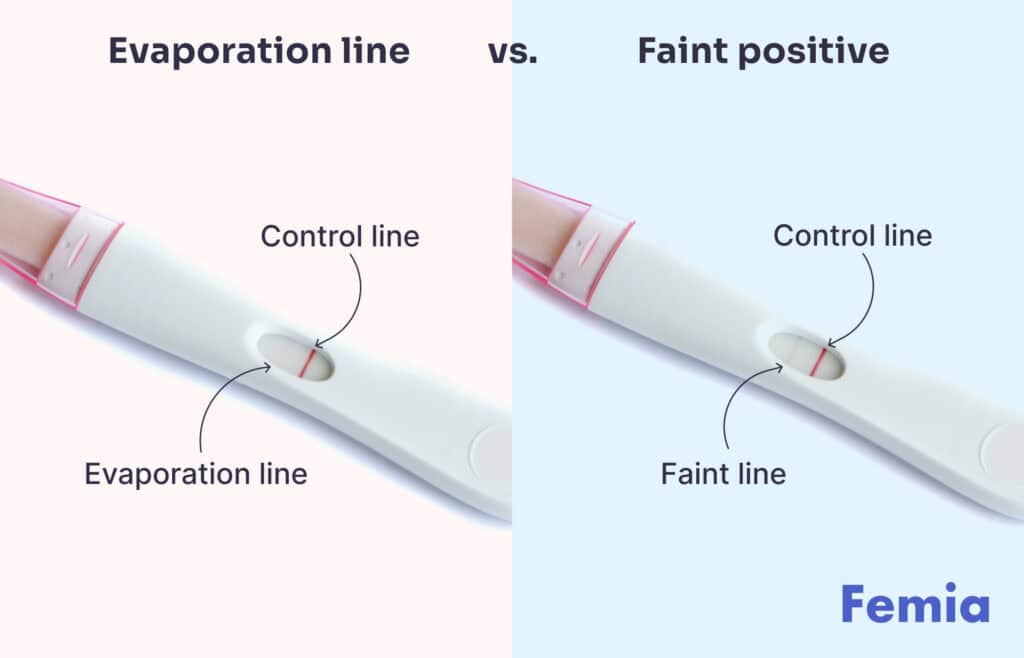
The biggest source of confusion is distinguishing a true faint positive from an evaporation line — a separate phenomenon that can appear once urine on the strip dries.
Color Is the Key Signal
An evaporation line forms as a physical residue, not a chemical reaction to hCG, so it tends to be color less or gray and can look streaky. A genuine faint positive line, by contrast, carries the test’s actual dye color pink or blue, just paler than a strong positive. If you can see any hint of that designated color within the test’s stated reading window (usually 3–5 minutes), it generally counts as a real result.
Timing Matters
Reading a test after the recommended window increases the odds of mistaking an evaporation line for a positive. Checking results outside that window, once the strip has dried, is one of the most frequent causes of false reassurance or false worry.
What to Do After Seeing a Faint Line
Retest With First-Morning Urine
Because hCG concentrates overnight, first-morning urine gives the clearest read. If your first test showed a faint line, testing again the next morning with a fresh test often produces a noticeably darker line.
Track Whether the Line Darkens
<cite index=”6-1″>In early pregnancy, hCG levels typically double roughly every 48 to 72 hours</cite>, so a true faint positive should progress to a clearer line within a few days. A line that stays exactly the same or fades is worth discussing with a healthcare provider, since it can sometimes signal a very early miscarriage (sometimes called a chemical pregnancy) or, less commonly, an ectopic pregnancy.
Consider a Blood Test for Certainty
If home tests keep giving you ambiguous results, a quantitative blood hCG test ordered by a doctor removes the guesswork — it measures the exact hormone level rather than relying on a visible line. Our pregnancy confirmation services can arrange blood testing and a same-week appointment if you’d like a definitive answer rather than repeating home tests.
When a Faint Line Might Signal Something Else
Not every faint line is a straightforward early positive. A few situations are worth flagging to your provider:
- Recurring faint lines over several days without darkening — worth a blood test to check whether hCG is rising appropriately.
- A faint line accompanied by pelvic pain or spotting — while common in early pregnancy, this combination should always be evaluated to rule out ectopic pregnancy.
- A faint line after fertility treatment involving hCG trigger shots — the medication itself can cause a false positive line for a short period.
If any of these apply to you, scheduling an evaluation with our prenatal care team can help confirm what’s going on and outline next steps.
Frequently Asked Questions
Is a faint line on a pregnancy test positive? Yes, in most cases. If the line has any visible color and appeared within the test’s reading window, it’s typically read as a positive result, even if it’s much lighter than the control line.
Can a faint line be a false positive? True false positives are rare. What’s usually mistaken for one is an evaporation line, which is colorless residue rather than a reaction to hCG.
How long after a faint positive should I retest? Retesting 2–3 days later with first-morning urine is usually enough to see whether the line has darkened, since hCG rises quickly in early pregnancy.
Why is my line darker on one test and fainter on another? Different brands have different sensitivity thresholds, so a more sensitive test can show a darker line at the same hCG level than a less sensitive one.
Does a faint line mean my hCG levels are low? Usually, yes — a faint line often reflects early testing, when hCG hasn’t built up much yet, rather than a problem with the pregnancy itself.
Should I be worried if my faint line doesn’t get darker? It’s worth getting a blood test if the line stays flat or fades over several days, as this can sometimes indicate an early pregnancy loss.
Can dehydration cause a faint line? Yes. Diluted urine from drinking a lot of fluids, or testing later in the day rather than first thing in the morning, can weaken the line’s intensity.
Is a digital test better than a strip test for a faint line? Digital tests remove line-reading ambiguity but usually require a higher hCG threshold to register “pregnant,” so they can sometimes read negative when a sensitive strip test shows a faint positive.
Final Thoughts
Seeing a faint line on a pregnancy test can feel like more of a question than an answer, but in most situations it does mean positive — your body just hasn’t produced enough hCG yet for a bold result. Retesting in a few days with first-morning urine, or getting a quantitative blood test, will usually give you the clarity you’re looking for. If you’d like a definitive result sooner rather than later, you can book a pregnancy confirmation appointment with our clinic this week.